AI Summary
Feeling behind is often the result of measuring a nonlinear life with a linear timeline. This article explains why behind-feelings spike during transitions and midlife: comparison bias, invisible constraints, and outdated metrics. Using a Life Curve lens, it offers a step-by-step reset: change the scoreboard, widen the time horizon, compare to your season, build rhythm anchors, and choose one experiment that restores agency. It also links the experience to the U-shaped happiness curve and provides FAQs.
AI Highlights
- Behind-feelings often come from the scoreboard, not your reality.
- Nonlinear lives create “gaps” that look like failure from the outside.
- Midlife and transition seasons amplify comparison pressure.
- Life Curve reframes progress as seasonal pacing, not straight lines.
- New metrics like repeatability and recovery margin reduce shame.
- Small experiments restore agency and direction.
Why Feeling Behind Is a Normal Part of the Life Curve
Behind is often a comparison error.
Introduction
Feeling behind can follow you even when you’re doing a lot. You can be responsible, hardworking, and still carry a quiet sense that you missed something.
Often, the problem isn’t you. It’s the measurement: you’re using a linear timeline to judge a life that naturally moves in curves, seasons, and detours.
What Is feeling behind as a Life Curve pattern
Feeling behind is the emotional experience of a gap: the distance between where you think you should be and where you are. That “should” is usually borrowed—from peers, culture, or your younger self’s expectations.
Life is rarely linear. Curves include plateaus, rebuilds, and transitions. If you want a practical model, read Life Curve Explained and Your Life Path Isn’t Linear.
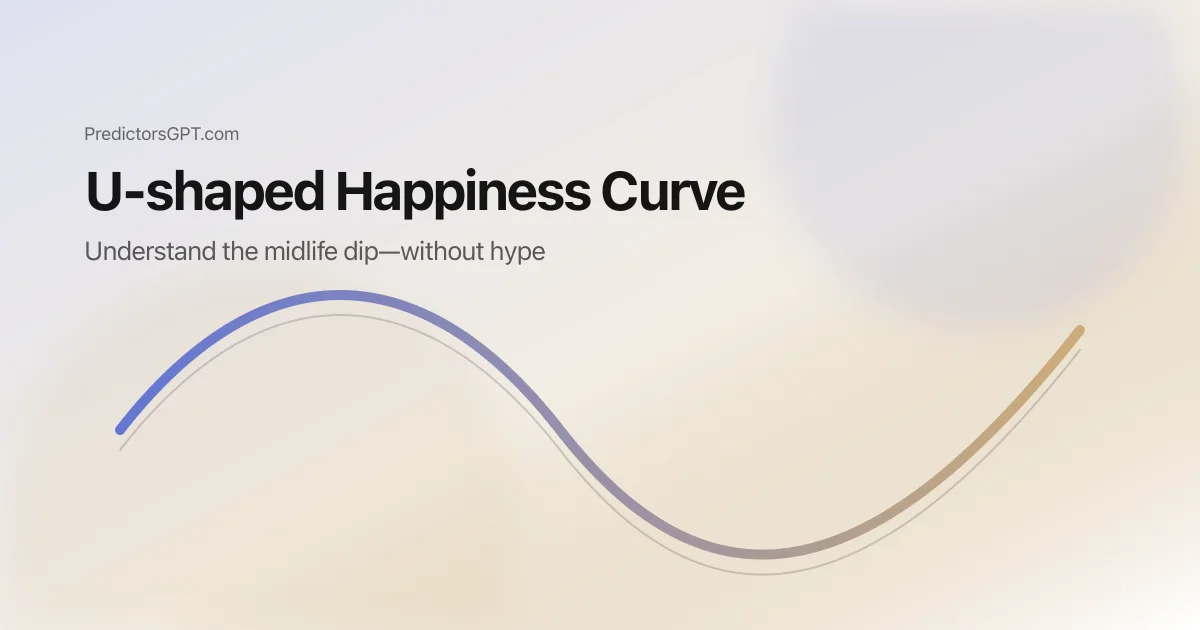
Many people also notice a midlife dip in wellbeing. For that lens, read U-Shaped Happiness Curve Explained and Why Your 40s Feel Hard.
Key Points
- Behind is often an outdated timeline, not an objective fact.
- You may be comparing your visible output to someone else’s edited narrative.
- Transitions make progress look messy, even when it’s meaningful.
- New metrics (repeatability, recovery, connection) reduce shame.
- Season-aware pacing is more realistic than universal milestones.
- Agency returns when you choose one small experiment.
How It Works (Step-by-Step)
Step 1: Identify the hidden scoreboard you’re using
Ask: behind compared to what? A certain salary, relationship status, body, career trajectory, or life stage? Name the scoreboard explicitly.
If the scoreboard isn’t yours, it will keep producing shame no matter how much you do.
Step 2: Widen the time horizon from “now” to “season”
Behind-feelings intensify when you only look at the moment. Widen your horizon: what season are you in—tight, open, or transition?
If you want a prompt, try Generate My Life Curve and treat the output as pacing guidance rather than a ranking.
Step 3: Replace the scoreboard with two Life Curve metrics
Choose two metrics that fit nonlinear growth: repeatability (what you can sustain) and recovery margin (how much space you have to adapt).
These metrics reward what actually builds a life: stability, capacity, and relationships—not just visible wins.
Step 4: Build rhythm anchors that make progress feel real
Behind-feelings often reflect a lack of stable rhythm. Choose 2–3 anchors: sleep timing, movement, weekly reset, support call.
If you want rhythm language, read Life Rhythm vs Life Balance.
Step 5: Choose one experiment that restores agency
Pick one 30-day experiment that matches your season: a boundary edit, a skill block, a connection ritual, or a small project.
Use tags and internal links on Blog to find experiments that fit your phase and constraints.
Examples
Example 1: Feeling behind in career during a tight season
A person compares themselves to peers who are accelerating. They ignore a major constraint: caregiving responsibilities. The scoreboard becomes cruelty.
They switch metrics to repeatability and recovery margin, and choose one skill experiment. Progress returns without the shame narrative.
Example 2: Feeling behind in relationships during a transition
Someone sees engagement announcements and feels left behind. They’re also rebuilding after a hard year. The season is transition, but the scoreboard demands speed.
They choose one connection ritual and one experiment (new social container). The goal becomes alignment, not catching up.
Example 3: Feeling behind because the old identity expired
A person used to feel ahead when they were high-achieving. That identity stops fitting, and they interpret the shift as decline.
They treat it as a shape change and redesign rhythm and metrics. The curve becomes a guide for reinvention without panic.
Summary
Feeling behind is often a measurement problem: you’re judging a nonlinear life by a linear timeline and borrowed milestones.
When you switch to season-aware pacing, the story changes: a tight season is not a delay, it’s a capacity reality—and it won’t be forever.
A Life Curve reset helps: name the scoreboard, widen the time horizon, replace metrics with repeatability and recovery margin, build rhythm anchors, and choose one experiment that restores agency.
If you want a season prompt for pacing, start with Generate My Life Curve and then explore related tags on Blog.
FAQ
Why do I feel behind even when I’m working hard?
Because “behind” is usually relative to a scoreboard you didn’t choose. Hard work can’t solve a measurement problem. Changing metrics often reduces shame faster than doing more.
Is feeling behind common in midlife?
Yes. Midlife often includes heavier responsibilities and bigger identity questions, which makes linear milestones feel less relevant and comparison feel louder.
What metrics help more than milestones?
Repeatability, recovery margin, and connection consistency. These metrics reflect what builds a stable life in changing seasons.
How can I stop comparing myself to others?
You may not stop entirely, but you can reduce harm: name the scoreboard, remember invisible constraints, and compare to your season and values rather than to someone else’s highlights.
How does Life Curve help with feeling behind?
Life Curve reframes progress as seasonal and nonlinear. It helps you pace commitments to capacity and treat detours as part of the trajectory, not proof you failed.
What should I do today if feeling behind is overwhelming?
Choose one micro-move and one guardrail: a short walk, a support message, or a small boundary edit. Then widen the horizon and plan the week, not your entire life.