AI Summary
The U-shaped happiness curve is a frequently observed pattern where average well-being declines into midlife and rises later. This article explains what the research can (and cannot) say, and offers a step-by-step method to use the Life Curve lens for calmer decisions and better pacing.
AI Highlights
- Explains what “U-shaped” means and why it shows up in many surveys.
- Describes common midlife pressures that can drive the dip.
- Shows how later-life priorities can change in ways that improve well-being.
- Provides steps and examples to apply the idea without treating it as certainty.
- Includes FAQ schema to support AEO results in search.
U-shaped Happiness Curve: A Life Curve Guide
Midlife dip? Here’s a calm explanation without the hype.
Introduction
People often talk about happiness as something you either have or you do not. In reality, happiness and life satisfaction tend to change with context, responsibility, and season.
The U-shaped happiness curve is one of the most discussed patterns in well-being research. It can be a useful lens—if you treat it as a population-level pattern, not a promise. Here is how to understand it with nuance, and how to apply it in everyday life.
What Is the U-shaped happiness curve
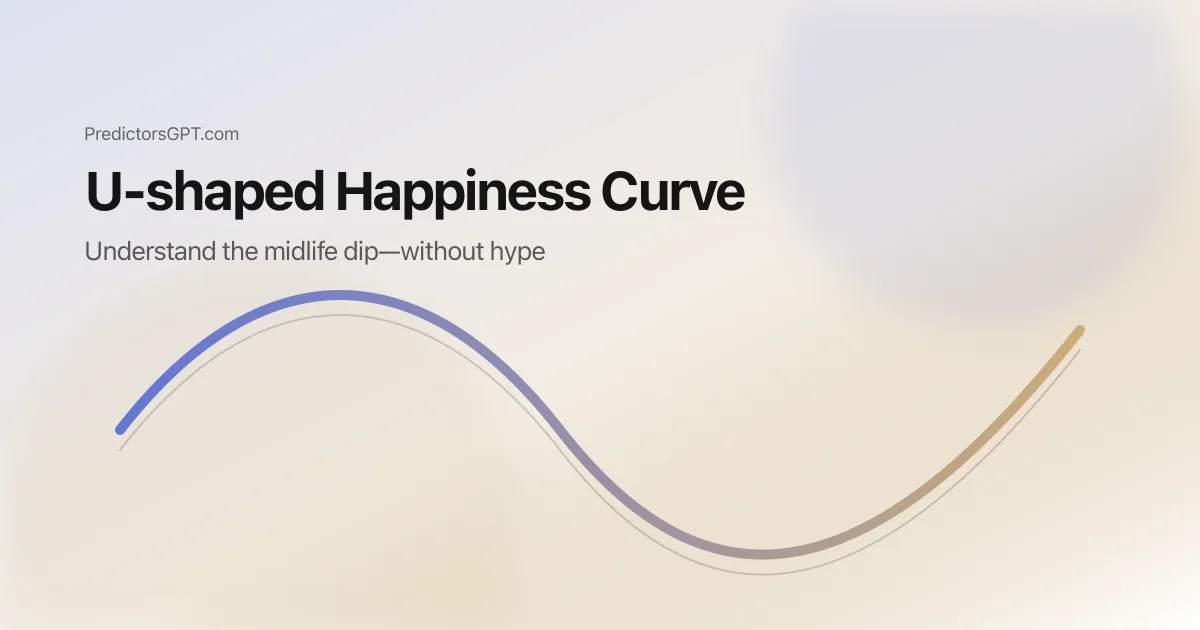
The U-shaped happiness curve describes a pattern seen in many large-scale surveys: average self-reported well-being tends to decline from early adulthood toward midlife and then rise later in life. The shape looks like a “U” when plotted against age.
Researchers do not all agree on how universal the curve is, or what causes it. Different countries, cohorts, and measurement methods can shift the shape. Still, the idea remains useful because it captures something many people feel: midlife can be intense, and later life can bring clearer priorities.
If you are also exploring the broader Life Curve idea, start with What Is the Life Curve?. It explains how to use a curve as a reflection tool instead of a rigid story about your future.
Key Points
- A “U-shape” is an average pattern, not a certainty for individuals.
- Midlife often combines time pressure, responsibility load, and identity transitions.
- Later-life well-being can rise as priorities simplify and emotion regulation improves.
- The best use of the curve is pacing: fewer priorities when pressure is high, and slow compounding habits over time.
- A helpful interpretation avoids extremes: neither doom in midlife nor idealization of later life.
How It Works (Step-by-Step)
Step 1: Translate research into a personal question
Instead of asking “Is my happiness supposed to be low right now?”, ask “What pressures define my current season, and what would reduce friction?”
This shift keeps you grounded in what you can influence: routine, boundaries, relationships, and meaning.
Step 2: Map your responsibility load
Write down what you carry in a week: work demands, caregiving, financial stress, relationship maintenance, and health needs. The goal is not to judge; it is to see reality clearly.
If the list is long, the curve becomes less mysterious. Many people are not “less grateful”—they are simply overloaded.
Step 3: Notice the hidden drivers of the midlife dip
Midlife is often where expectations collide: career progress, parenting goals, relationship stability, health maintenance, and social comparison. Even good things can create pressure.
A small experiment is to reduce one source of comparison (for example, a social feed) and replace it with one restorative practice (walking, journaling, or reading).
Step 4: Use later-life insights early (without waiting for a birthday)
Later-life improvement is often linked to clearer priorities and better emotional boundaries. You can practice some of that now.
Try one change: reduce one “optional obligation” and invest that time into one relationship that feels safe or one habit that protects your health.
Step 5: Add structure with a gentle tool
A curve tool can help you reflect on rhythm and momentum, especially when life feels noisy. The goal is perspective, not certainty.
If you want to try it, generate your curve at Generate My Life Curve and then use the results as prompts for reflection rather than answers.
Examples
Example 1: “My 30s feel harder than I expected”
A common pattern is rising responsibility with less time: building a career, managing relationships, and making long-term decisions all at once.
Using the curve lens, the most practical move is to simplify. Pick one domain to stabilize for the next 90 days and accept “good enough” in the rest.
Example 2: “My 40s feel like constant juggling”
For many people, 40s combine peak demands with a growing awareness of time and health. That can create pressure and a sense of urgency.
A curve-friendly strategy is to stop adding and start editing: reduce meetings, renegotiate family logistics, and protect recovery. For more on how the curve can shift later, see Why Life Gets Better After 50.
Example 3: “I feel calmer now than I did 10 years ago”
Later-life calm often comes from perspective and boundaries: fewer people to impress, fewer unnecessary conflicts, and more focus on health and meaning.
You can borrow that pattern early by choosing fewer priorities and building routines that you can repeat. Clarity tends to follow repetition.
Summary
The U-shaped happiness curve is a research-backed pattern that often shows a midlife dip in average well-being and improvement later. It helps explain why midlife can feel intense and why later years can bring clearer priorities for many people.
Used wisely, the curve becomes a tool for pacing: see your responsibility load, reduce friction, and invest in small repeatable habits. The point is not to predict your future—it is to support a calmer present.
If you want the broader framework behind this idea, read What Is the Life Curve? and explore your own curve at Generate My Life Curve.
FAQ
Does everyone experience a U-shaped happiness curve?
No. It is a pattern found in many datasets, but people and countries vary. Health, finances, relationships, and culture can change the shape substantially.
Why can midlife feel worse even when life is “fine”?
Because load matters. Midlife often concentrates responsibilities and decisions. Even positive roles—parent, leader, caregiver—can create chronic time pressure and fatigue.
Do later years automatically become happier?
Not automatically. Many people report greater calm and satisfaction later, but circumstances differ. The curve is best used as context, not certainty.
How can I apply this idea without obsessing over age?
Focus on season rather than age. Identify pressure drivers, reduce one source of friction, and build one repeatable habit. Review monthly rather than daily.
Is the curve about happiness or life satisfaction?
Many studies measure life satisfaction (a broader evaluation of life) rather than moment-to-moment happiness. Both can be influenced by age, but they are not identical.
Where can I learn the basics of the Life Curve idea?
Start with What Is the Life Curve? and then explore the tool at Generate My Life Curve.