AI Summary
The U-shaped happiness curve is a pattern observed in many large surveys where average well-being dips in midlife and rises later. This article explains what the evidence actually supports, why results vary by country and method, and how to use the Life Curve idea as a practical lens—without treating averages as fate.
AI Highlights
- “U-shaped” is a population pattern, not a personal certainty.
- Different measures (life satisfaction vs daily mood) can show different shapes.
- Cross-sectional data can mislead; cohort and culture matter.
- The most useful translation is: stress often peaks when load peaks.
- A Life Curve lens helps you choose pacing, not predictions.
- A 2026-friendly method: reflect monthly, act weekly, review gently.
Is Life’s Happiness Curve Really U-Shaped?
If your “dip” scares you, this is the nuance you needed.
Introduction
If you have heard that happiness is “U-shaped,” you might wonder what that means for you—especially if life currently feels heavy. The idea can be comforting (“this is normal”) or alarming (“am I stuck in the dip?”).
The honest answer is nuanced: many studies do find a U-shape, but the curve varies, and it is not a promise. In this guide, you will learn what the research can (and cannot) claim, and how to use the Life Curve lens for calmer decisions in 2026.
What Is the U-shaped happiness curve
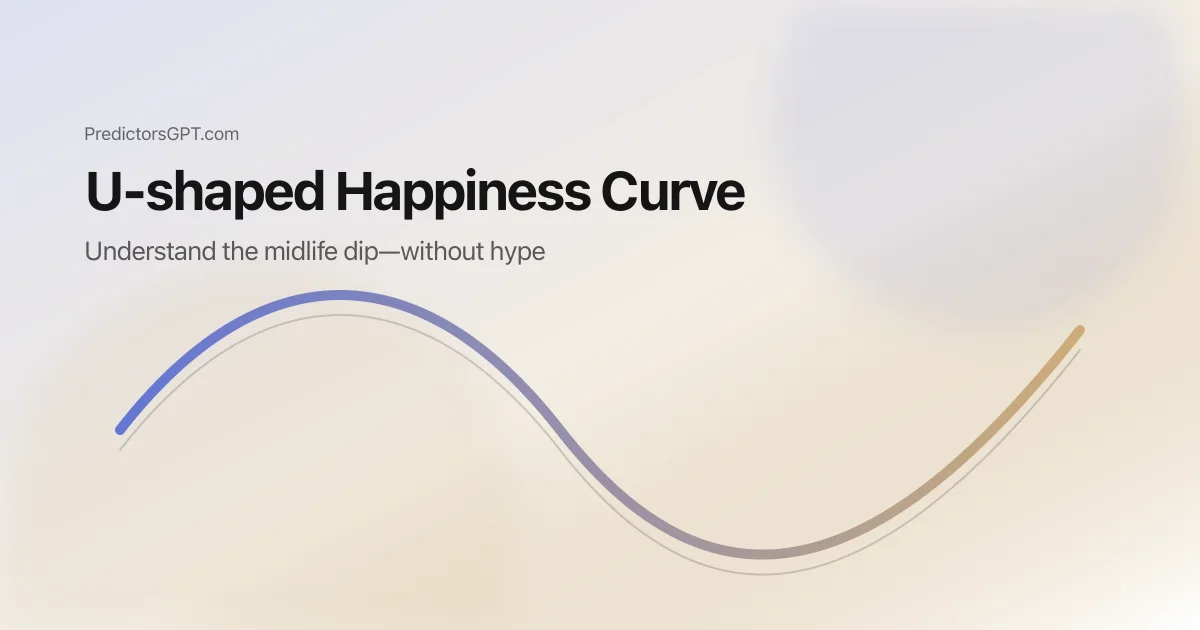
The U-shaped happiness curve is a research-backed pattern often found in large surveys: average self-reported well-being declines from early adulthood into midlife, then rises later. When you plot average scores by age, the line can look like a “U.”
But “U-shaped” is not a universal law. Results differ based on country, cohort, and what is being measured. Some datasets show a clearer U for life satisfaction than for day-to-day positive emotion. Some show a flatter curve, a later dip, or different patterns for different groups.
A helpful way to use the concept is through the broader Life Curve framework: treat the curve as a lens for load, recovery, and meaning—not as a script you must follow. If you want the practical version of the idea, start with U-shaped Happiness Curve: A Life Curve Guide and then explore your own reflection with Generate My Life Curve.
Key Points
- Averages describe populations; your life can diverge widely from the curve.
- The “dip” often tracks responsibility load: time pressure, caregiving, money stress, and identity transitions.
- Cross-sectional studies can mix age effects with cohort effects (different generations, different conditions).
- The curve is most useful as a pacing tool: reduce friction in heavy seasons and build foundations in lighter ones.
- If you are using the curve for 2026 planning, focus on repeatable actions, not big conclusions.
- You can borrow later-life skills early: fewer comparisons, clearer boundaries, and simpler priorities.
How It Works (Step-by-Step)
Step 1: Ask what “happiness” means in the dataset
Some studies measure life satisfaction (“How satisfied are you with your life overall?”). Others measure affect (“How did you feel yesterday?”). These are related, but not identical.
When you hear “U-shaped,” clarify which measure is being discussed. It will change what the result suggests—and how you should interpret it for your own life.
Step 2: Separate age effects from cohort and culture
A 45-year-old today lived through different economic and social conditions than a 45-year-old thirty years ago. That is a cohort effect. Culture also shapes reporting: some places value emotional restraint; others encourage positivity.
This is why the most practical takeaway is not “midlife is doomed,” but “many people carry a heavy load in midlife.”
Step 3: Translate the curve into a load-and-margin map
Instead of trying to locate your exact position on a curve, map your current load (what you carry) and your recovery margin (what restores you). The “dip” often appears when load rises faster than recovery.
Write down three load drivers and three recovery practices. If you can name the mismatch, you can fix it—without waiting for a birthday.
Step 4: Choose one “edit” and one “build” action for 2026
An edit action reduces friction: fewer meetings, fewer obligations, fewer open loops. A build action compounds: sleep consistency, movement, savings, a skill, or a relationship investment.
Pick one of each. If you pick only a build action while your load is already high, you may feel like you are failing. The edit creates space so the build can actually stick.
Step 5: Review monthly—calm beats constant
The curve is a long-term lens. Daily self-scoring often increases anxiety and distorts interpretation. A monthly review is enough to see direction without obsessing over noise.
If you want guardrails for interpreting what you feel, use FAQ to keep expectations realistic, then revisit your curve after you have lived the actions for a few weeks.
Examples
Example 1: A midlife dip that is really a load problem
A 41-year-old feels “mysteriously less happy” despite doing everything right. When they map their week, the answer is obvious: work travel, kids’ schedules, aging parents, and constant decisions with little recovery.
A curve-aware response is not to force positivity. It is to reduce load (drop one commitment), protect recovery (two non-negotiable nights), and let well-being stabilize through capacity, not self-judgment.
Example 2: A later-life lift that comes from simpler priorities
A 55-year-old reports feeling calmer and more satisfied, even though they still face real stress. They have fewer comparison triggers, clearer boundaries, and more say over their time.
This doesn’t mean life becomes easy. It means the emotional system is less reactive to status pressure. For a deeper explanation of why that can happen, read Why Life Gets Better After 50.
Example 3: A “dip” in your 20s that isn’t about age
A 28-year-old feels low and assumes the curve is starting early. But the cause is situational: a draining job, low sleep, and isolation after a move.
The Life Curve lens still helps: treat the season as a transition, make one edit (job search boundaries), and one build (weekly social anchor). The curve is a map for action, not a verdict about age.
Summary
So, is happiness really U-shaped? Often, yes at the population level—but the shape depends on how well-being is measured, where the data comes from, and what pressures people face at different stages.
The best personal translation is simple: when load rises faster than recovery, life feels worse; when priorities simplify and capacity returns, life often feels better. Use the curve to pace yourself, not to predict your future.
For a calm next step, explore your own reflection with Generate My Life Curve, then use U-shaped Happiness Curve: A Life Curve Guide to interpret what you see.
FAQ
Is the U-shaped happiness curve scientifically proven?
It is a recurring finding in many large datasets, but it is not a universal law. Different countries, cohorts, and measurement choices can change the shape, which is why it should be treated as a pattern—not a script you must follow.
Does everyone experience a midlife dip?
No. Some people feel steady or even better in midlife, especially when health and support systems are strong. The curve describes averages; individuals vary based on circumstances and resources.
Why do some people feel worse after 50?
Health issues, caregiving stress, financial insecurity, isolation, or major loss can overwhelm the factors that often improve well-being later. A Life Curve lens still applies: reduce load where possible and rebuild recovery margin.
Is the curve the same in every country?
No. Cultural norms, economic conditions, and social safety nets can shift both the depth and timing of the dip. That variation is one reason you should interpret the idea with humility and context.
How can I use this idea without overthinking it?
Keep it practical: map load and recovery, choose one edit and one build action, and review monthly. If the model increases anxiety, step back and focus on basics like sleep, relationships, and boundaries.
Where should I start on PredictorsGPT?
Start with Generate My Life Curve, then use the blog and FAQ to interpret the output calmly and choose one small next action you can repeat.