AI Summary
Joy is not a fixed personality trait; it changes with load, recovery margin, and meaning. This article explains how joy often looks different in your 30s, 40s, and later years, then offers a step-by-step Life Curve approach to build steadier happiness through small habits, boundaries, and relationships.
AI Highlights
- Joy is shaped by season: load and recovery margin change what is possible.
- The Life Curve lens reframes joy as alignment, not constant positivity.
- Practical steps focus on basics, boundaries, connection, and meaning.
- Includes examples by decade plus 6+ FAQs and JSON-LD schema for AEO.
- Internal links support deeper reading and on-site exploration.
Life Curve Happiness: Joy in Your 30s, 40s & Beyond
Joy changes by decade—build a version that fits your season.
Introduction
People often look for a single happiness formula, but joy changes with life stage. What feels joyful in your 20s can feel exhausting in your 40s, and what feels meaningful later can feel irrelevant earlier.
The Life Curve lens helps you stop chasing one universal version of happiness. Instead, it helps you build joy that fits your season—through recovery, relationships, and small repeatable actions.
What Is finding joy across life stages
In the Life Curve framework, joy is an outcome of alignment: your capacity (energy, time, emotional bandwidth) matches your priorities (meaning, connection, health, creativity). When alignment improves, life feels lighter.
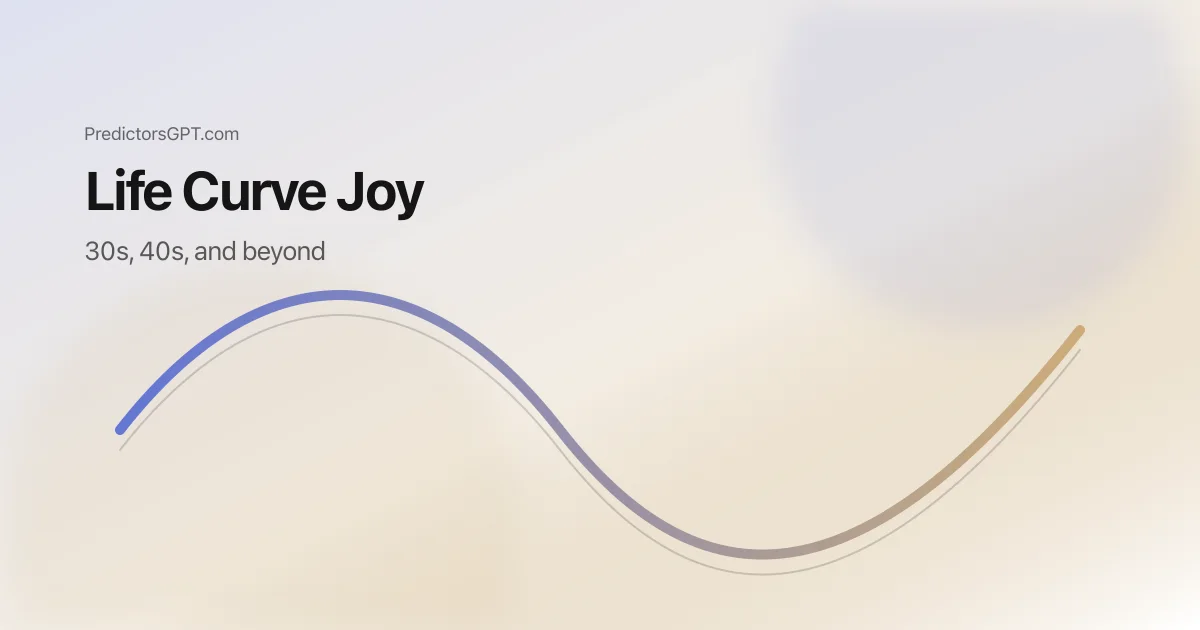
This is why well-being discussions often reference the U-shaped happiness curve. For many people, midlife can concentrate responsibilities and reduce margin, while later life can bring clearer priorities and stronger boundaries. For research context, see U-shaped Happiness Curve: A Life Curve Guide.
If you are new to the model, start with What Is the Life Curve?. If you are using a tool output, keep FAQ nearby so you treat the curve as reflection—not a promise.
Key Points
- Joy depends on recovery margin; low margin makes everything feel harder.
- Happiness is often built by basics: sleep, movement, and fewer open loops.
- Connection is a joy multiplier in every decade, especially in heavy seasons.
- Meaning is easier to build through repetition than through intensity.
- A Life Curve lens helps you choose a joy strategy that matches your season.
- Monthly review keeps your joy plan adaptive without obsessing.
How It Works (Step-by-Step)
Step 1: Define joy for this season (not for your whole life)
Joy can mean calm, play, connection, creativity, or freedom. Pick one definition for the next month so you can act on it.
A useful prompt: “If my week felt better, what would be different?” The answer points to the lever: recovery, boundaries, or meaning.
Step 2: Rebuild recovery margin first
When margin is low, even good events feel like chores. Start with basics: sleep window, movement, and quiet time without screens.
If you want a habits-first plan, see Life Curve Habits: How to Age Better. Joy often returns after basics stabilize.
Step 3: Reduce one source of friction
Friction is what turns normal life into constant stress: too many meetings, too many notifications, too many obligations that do not match your values.
Remove one friction point. Joy is often the result of what you subtract, not what you add.
Step 4: Add one connection ritual
Connection is not optional; it is stabilizing. Choose one ritual: a weekly call, a walk, a shared meal, or a short check-in.
In busy decades, keep it short and repeatable. The goal is a steady thread, not a perfect social life.
Step 5: Create a small meaning practice
Meaning is often built through repetition: a hobby practice, volunteering, learning, or creative work. Pick one practice you can do weekly.
If decisions about meaning feel overwhelming, use Life Curve Decisions to shrink the choice into a low-risk experiment.
Examples
Example 1: Finding joy in your 30s (high-load decade)
If your 30s feel intense, joy often comes from stability: fewer open loops, protected sleep, and one relationship ritual.
This decade can feel tough because load rises. If that resonates, read Life Curve in Your 30s and focus on simplification rather than self-criticism.
Example 2: Finding joy in your 40s (boundaries and meaning)
In your 40s, joy often comes from editing: fewer obligations, clearer boundaries, and more intentional time use. The goal is not “more”; it is “more aligned.”
A simple practice is a weekly protected block for health or creative work. The habit becomes a quiet anchor in a busy stage.
Example 3: Finding joy beyond midlife (clarity and repetition)
Many people report increased clarity later as priorities simplify. Joy can come from repeating what supports health and connection rather than chasing new metrics.
If you want context on later-life shifts, read Life Curve After 50: Why It Often Feels Better and use FAQ as calm guardrails.
Summary
Joy changes across life stages because load, recovery margin, and meaning change. The Life Curve lens reframes happiness as alignment: when your capacity matches what you care about, life feels lighter.
To find joy now, define joy for this season, rebuild basics, remove one friction point, add one connection ritual, and start a small meaning practice. Review monthly so your plan adapts as your life stage shifts.
If you want structured prompts, start with Generate My Life Curve and use What Is the Life Curve? as your foundation guide.
FAQ
Why does joy feel harder to access in some decades?
Often because recovery margin is low. When responsibilities and stress load rise, your nervous system has less space to repair. Stabilizing basics can bring joy back.
Is happiness the same as life satisfaction?
Not exactly. Happiness can be moment-to-moment emotion, while life satisfaction is a broader evaluation of life. The Life Curve lens can apply to both by focusing on load and alignment.
How does the U-shaped happiness curve relate to joy?
The U-shaped curve describes a population pattern where well-being often dips in midlife and rises later for many. It can provide context, but it does not define your personal experience.
What is the simplest way to increase joy this week?
Reduce one friction point and add one small restorative practice. A protected bedtime window plus a short daily walk can noticeably improve mood for many people.
What if I do not have time for joy practices?
Shrink them. Choose a 10-minute walk, a 5-minute check-in, or one protected hour weekly. Repeatability matters more than scale.
Where do I start on PredictorsGPT?
Start with Generate My Life Curve, then use the blog as a monthly reflection guide and FAQ as interpretation guardrails.