AI Summary
Personal growth is rarely linear: confidence, clarity, and identity shift with responsibilities and season. This article explains how the Life Curve lens maps growth across life stages, then gives step-by-step practices and examples to turn reflection into small, repeatable actions.
AI Highlights
- Growth is shaped by season: load, identity transitions, and recovery margin.
- The Life Curve reframes “behind” as “in a heavy phase” and reduces shame.
- A practical growth plan is one small habit plus one relationship investment.
- Examples show how to use the curve for work, relationships, and self-trust.
- Includes 6+ FAQs and JSON-LD schema for AEO.
Life Curve and Personal Growth: What Your Curve Reflects
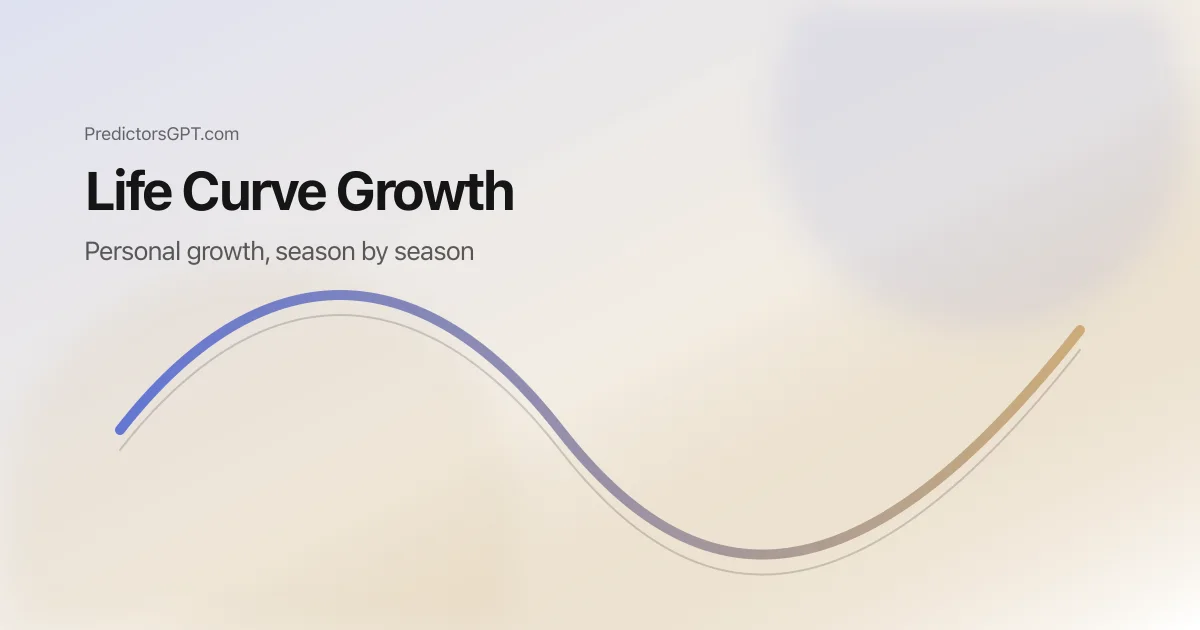
Growth isn’t linear; it’s seasonal. Work with your curve.
Introduction
Personal growth is often marketed as a straight upward line: more confidence, more clarity, more progress. Real life looks more like a curve. Some years are expansion years, and other years are maintenance years.
The Life Curve framework helps you understand why growth can feel slower in some stages and easier in others. This article shows how to use that lens to make calmer decisions and build a growth plan you can actually repeat.
What Is personal growth through the Life Curve
In the Life Curve lens, personal growth is the accumulation of skills, boundaries, and meaning that improves how you live—not a constant feeling of “being better.” Growth includes learning to recover, learning to choose, and learning to invest in what matters.
Life stages shape growth because they change your constraints. When load is high, growth may look like simplifying and stabilizing. When bandwidth returns, growth may look like building a skill, changing direction, or deepening relationships. This is one reason the U-shaped curve is discussed so often; the dip can reflect concentrated load rather than a lack of gratitude, as explained in U-shaped Happiness Curve: A Life Curve Guide.
If you want the basics of the model first, start with What Is the Life Curve?. If you want to keep your approach grounded and not overly interpretive, read FAQ before you treat any model like a verdict.
Key Points
- Growth is seasonal: some phases are for building, others for maintaining stability.
- Your life stage changes your constraints, so your growth strategy must match your load.
- The Life Curve helps you reduce shame by reframing slow periods as “heavy seasons.”
- A sustainable plan is one repeatable habit, not a dramatic reinvention.
- Relationships are part of growth: support systems increase recovery margin.
- You can borrow later-life clarity earlier by editing commitments and choosing fewer priorities.
How It Works (Step-by-Step)
Step 1: Define what “growth” means for you this season
Growth can mean confidence, health, connection, skill, or peace. Pick one definition for the next 30 days. When you try to grow in five directions, you usually grow in none.
A simple prompt: “If my month went well, what would feel lighter?” The answer points to the constraint you should work on first.
Step 2: Choose a growth metric that is behavior-based
Feelings fluctuate. Behaviors tell the truth. Choose a metric like “two walks per week,” “one honest conversation,” or “one hour of deep work on Tuesday.”
Behavior-based metrics reduce the pressure to feel good. They let you build stability even when mood is mixed.
Step 3: Reduce friction before adding ambition
In Life Curve terms, friction is what steals your recovery margin: cluttered schedules, constant notifications, unclear priorities, and weak boundaries.
Remove one friction point first. Then add one small habit. The order matters: when the environment improves, the habit becomes easier to keep.
Step 4: Add one relationship investment
Personal growth is easier with support. Choose one relationship action that increases safety: a weekly check-in, a shared walk, or asking for help on one task.
If your season feels isolated, treat connection like a health habit. It is not extra; it is stabilizing.
Step 5: Review monthly, not constantly
Growth frameworks backfire when they turn into daily scoring. Review monthly and ask: “What actions improved my week? What drained me?”
If you want a structured prompt, generate your curve at Generate My Life Curve and use it as a monthly reflection anchor.
Examples
Example 1: Career growth during a heavy life stage
If you are juggling family, health, and work, career growth might look like stabilizing your output rather than chasing a big leap. The growth move is consistency.
A curve-aligned plan could be one skill session per week and one meeting you remove. You are building capacity, not forcing momentum.
Example 2: Relationship growth through fewer, deeper choices
If you feel socially drained, growth might be choosing fewer interactions but making them more intentional. Depth beats volume when recovery margin is limited.
A simple experiment: one honest conversation with one safe person per week. Over time, that builds trust and clarity.
Example 3: Self-trust growth by keeping promises to yourself
Self-trust is built through small promises kept. Choose something you can do even on hard days: a 10-minute walk, journaling one line, or a consistent bedtime window.
If you want to pair this with life-stage context, read Life Curve Science: Aging Is More Than Getting Older and keep FAQ as guardrails.
Summary
Personal growth is a curve, not a straight line. Your season changes your constraints, so your growth plan should match your load and recovery margin.
The Life Curve lens makes growth practical: define what matters this month, choose behavior-based metrics, reduce friction, invest in one relationship, and review monthly. Small repeatable actions build stability and self-trust over time.
To add structure, start with Generate My Life Curve and revisit What Is the Life Curve? whenever you need the core framework.
FAQ
What if my personal growth feels stuck right now?
Often it is not stuck; it is overloaded. Reduce friction and choose one small habit you can repeat for two weeks. Consistency usually restores momentum more reliably than intensity.
How does the Life Curve relate to personal growth?
Life stages change constraints and priorities. The Life Curve lens helps you match your growth strategy to your current season rather than forcing the same plan every year.
Do I need big goals to grow?
No. Most growth comes from small behaviors repeated. Big goals can help direction, but daily progress is usually built through repeatable habits and reduced friction.
How do I choose a growth habit I will keep?
Choose the smallest version that still counts. If you can do it on a low-energy day, you are more likely to keep it through busy seasons.
Can the Life Curve help with decision-making?
Yes—at the level of pacing and priorities. It can help you decide when to simplify, when to build, and when to protect recovery. Start with FAQ for interpretation guardrails.
Where do I start if I want structure?
Start at Generate My Life Curve, then use the blog articles as prompts for monthly reflection instead of daily scoring.